
How to Check Criminal History in Lafayette Parish
No single database contains every Lafayette Parish criminal record. The Lafayette Parish Sheriff’s Office (LPSO) handles current custody, booking material, parish reports, and local checks. The Lafayette Parish Clerk holds filed district-court charges and outcomes in ClerkConnect, while Lafayette City Court keeps a separate misdemeanor, traffic, OWI, ordinance, and juvenile docket. Louisiana State Police provides fingerprint-based review of a person’s own state history.
The official LPSO homepage shows the agency routes that begin a recent-custody inquiry.

A booking entry and a filed case are different records even when they concern the same event.
- Identify the need: present custody, a report, a filed case, a city matter, or your own statewide record.
- For a recent arrest, check LPSO custody and spelling variants; a missing result can mean release, transfer, delay, confidentiality, or another jurisdiction.
- Search district cases in ClerkConnect and check Lafayette City Court separately when its jurisdiction may apply.
- Compare intake charge, prosecutor-filed charge, minutes, disposition, and sentence.
- Order source documents when exact legal effect matters; use fingerprints for official statewide self-review.
The flow is arresting agency → LPSO booking → district attorney decision → clerk disposition → reporting to LACCH. Each transition may change what the record says.
One History, Four Lafayette Record Custodians
Lafayette Parish criminal history is easiest to understand by custodian. LPSO’s product is custody-centered; the Clerk’s file is case-centered; Lafayette City Court keeps its own docket; and the Louisiana Computerized Criminal History system is identity-centered. Older paper files, reporting delays, names, and missing dispositions can make them disagree.
LPSO Records
316 W. Main St., Lafayette, LA 70501
337-236-5845
Monday–Friday, 8 a.m.–5 p.m.
Clerk Criminal Department
800 S. Buchanan St., Lafayette, LA 70501
337-291-6329
Filed cases and certified copies
Lafayette City Court
105 E. Convent St., Lafayette, LA 70501
337-291-8720
City-jurisdiction dockets
Verify each entry with its author. The courthouse is the destination for filed charges and judgments, not police reports. LPSO Records supplies sheriff reports and booking products, not signed judgments. City Court’s free docket does not replace its official file.
Official Louisiana Background Checks
Louisiana State Police BCII-LCJIS maintains LACCH, but Louisiana has no unrestricted public statewide name search. The Internet Background Check portal is limited to uses authorized by Louisiana law. A person reviewing their own certified Louisiana history uses fingerprint-based Right to Review through LAPS.
The BCII page is the official self-review and correction source.
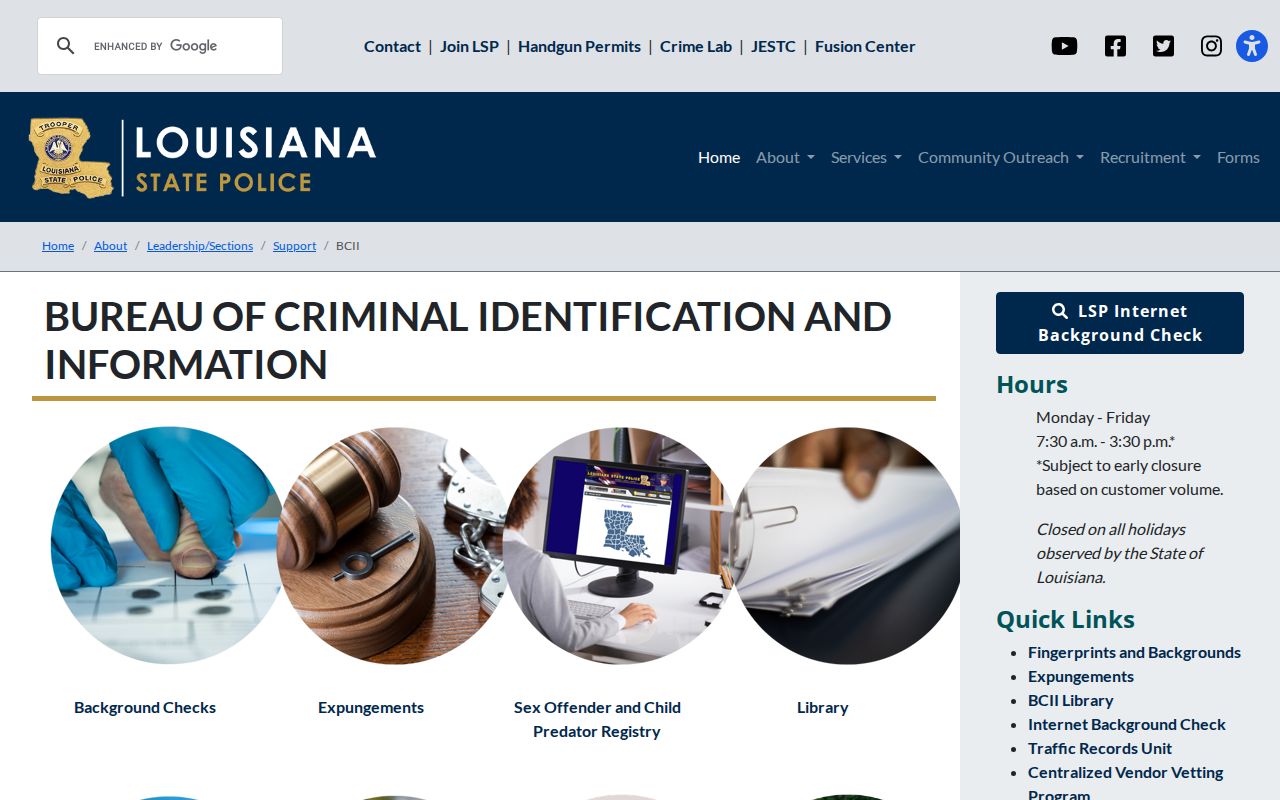
Right to Review can expose an arrest cycle needing a corrected disposition; it does not provide Lafayette Clerk images.
The reviewed form states $31 processing and $10 fingerprinting at LSP Headquarters. LSP also announced a $5 technology fee beginning December 1, 2024, and vendor charges can differ. Mail requires two FD-258 cards and authorization and disclosure forms. LPSO ink cards cost $25 each. Confirm the live total before submitting.
ClerkConnect’s Paid Lafayette Case Window
ClerkConnect is the paid remote source for Lafayette Parish district criminal and traffic information. The clerk confirms offense date, filed charge, case history, service, minutes, and disposition. Purchasing moved there in 2025, so former clerk-managed usernames no longer work.
The assigned portal image shows the correct entry point.
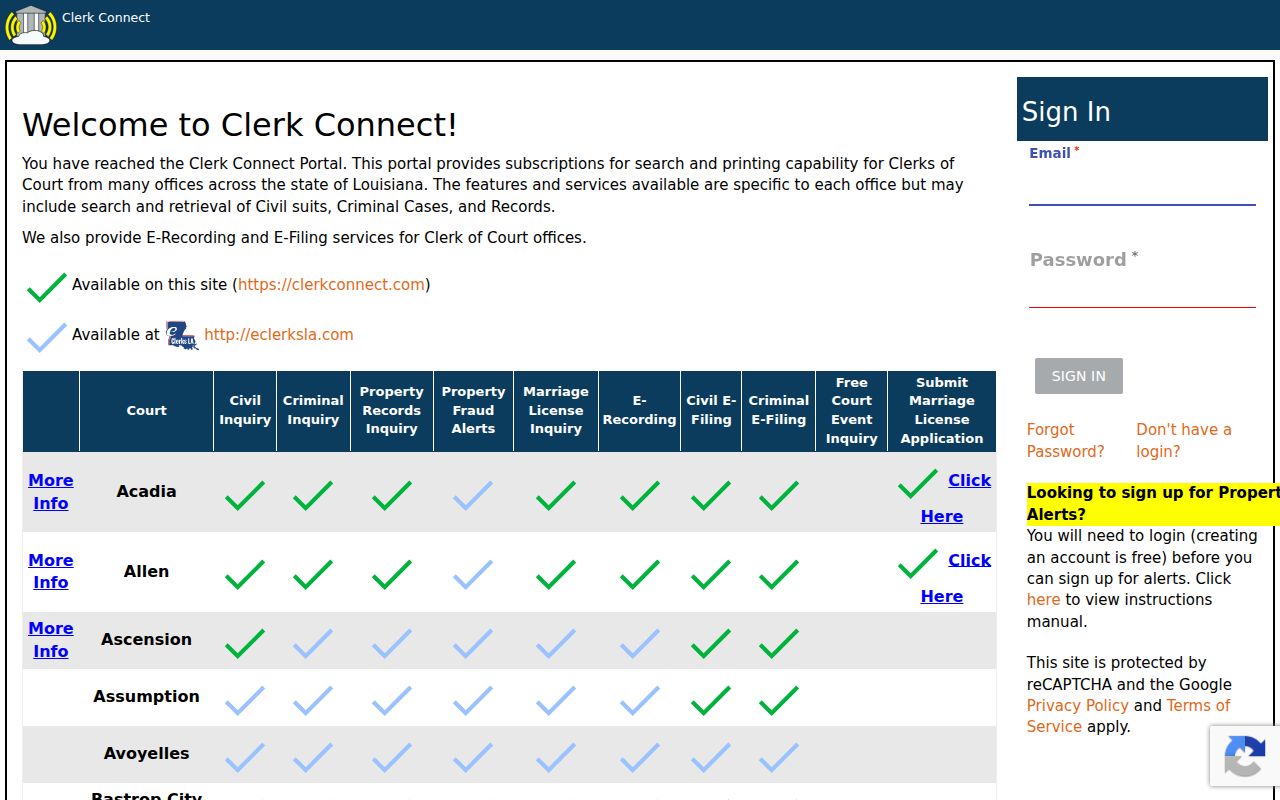
Full query controls are gated, so unpublished dropdowns should not be guessed.
| Portal item | Access | Meaning |
|---|---|---|
| Login | Required | Registration and subscription control queries. |
| Parish | Select Lafayette | Services differ among participating clerks. |
| Case/party search | Gated | Exact fields require access. |
| Subscription | Credit card | $10/day, $25/30 days, $300/year. |
Printed pages cost $1 except minute entries at $10. Call 337-291-6329 for certified judgments, older files, or a one-off copy rather than assuming a subscription is economical.
Types of Criminal Records in Lafayette Parish
A Lafayette Parish criminal history can include reports, bookings, charging papers, minutes, warrants, supervision data, and registry information. Each begins at a different stage and has different access rules.
- Reports: investigating agencies create initial and supplemental material; ongoing investigation may remain protected.
- Bookings: LPSO records intake, agency, charges, bond, and release, but arrest is not guilt.
- Court files: the clerk records filed charges, service, hearings, outcomes, sentence, and costs.
- LACCH: State Police organizes fingerprint-linked arrest cycles and reported dispositions.
- Warrants and supervision: courts and executing agencies control warrants; DPS&C holds felony supervision.
- Registry listings: LSP BCII maintains public information supplied through local registration.
The dedicated Lafayette Parish arrest history coverage follows booking channels without treating an intake charge or photograph as proof of conviction.
The LPSO Records Request Trap
LPSO accepts requests only in person, at recordsrequest@lafayettesheriff.com, or by mail to Captain John Mowell, LPSO, P.O. Box 3508, Lafayette, LA 70502. Another route, including delivery to an undesignated employee, is not deemed received. State the report number if known, date, location, record type, delivery choice, and certification need.
The Records page publishes the routes and July 1, 2026 fees.

Allow 7–10 business days before requesting an accident report.
| Product | Fee |
|---|---|
| Initial report | $10 |
| Incident report | $10 plus $1/supplement page |
| Daily booking report | $10 |
| Parish check | $30 |
| Clearance letter | $35 |
| Ink card | $25 |
The $30 local check is not statewide Right to Review. Call before mailing payment because every payment method is not stated publicly. If material is withheld, ask for the legal basis and segregable public portions.
What a Lafayette Parish Criminal Record Shows
A rap sheet organizes identity and arrest cycles, a court file organizes a case, and a jail record organizes custody. Their schemas are not interchangeable, and a signed or certified document is preferable when a summary is ambiguous.
| Identifiers | Names, aliases, birth date, and assigned SID or FBI identifiers. |
|---|---|
| Booking | Date, agency, intake charge, bond, release, and custody. |
| Charges | Intake accusation or prosecutor-filed charge, which can differ. |
| Disposition | Dismissal, nolle prosequi, plea, conviction, acquittal, or another result. |
| Sentence | Confinement, suspended term, probation, restitution, costs, or conditions. |
| Supervision | Jail, prison, probation, or parole information. |
A booking charge records the accusation at intake. The bill of information records the prosecutor’s decision. The disposition records what happened in court. A complete Lafayette Parish criminal history keeps those stages separate.
Reading Lafayette Dispositions in Plain Terms
Louisiana terminology changes how a record reads. The exact minute language and the statute effective on the offense date control; Louisiana has no universal Class A/B/C offense grid. Article 893 or 894 wording can also matter in later expungement analysis.
- Disposition
- The current or final outcome, such as dismissal, plea, conviction, or acquittal.
- Nolle prosequi
- A prosecutor’s decision not to continue at that time; it does not erase the arrest.
- Bill of information
- The district attorney’s filed charging document.
- Capias or attachment
- A court command directing custody, often following nonappearance.
- Expungement
- Removal of eligible records from public access, not destruction.
Confirm shorthand against the minutes and final judgment. A dismissal, acquittal, or completed diversion may affect the case result without automatically removing the underlying arrest cycle from every system.
Public Access Laws for Lafayette Parish Criminal Records
Louisiana Public Records Law starts broadly, but criminal files have specific exceptions. R.S. 44:3 protects specified investigations while keeping initial reports, Article 228 bookings, summonses or citations, and filed bills of information public. Victim, juvenile, medical, security, sealed, and expunged information can be withheld or redacted.
Key Louisiana authorities:
La. R.S. 44:1 broadly defines public records.
La. R.S. 44:3 governs law-enforcement access and exemptions.
Art. 971 states that expungement restricts access without destruction.
Art. 973 preserves specified authorized access.
Public availability does not authorize harassment, threats, retaliation, or unlawful registry use. Ask the custodian to identify the legal basis when a Lafayette Parish criminal record is withheld.
Why Lafayette Warrant Checks Need Confirmation
The LPSO offender platform advertises active warrants in its own records, not every municipal, state, or federal warrant. Confirm LPSO information at 337-236-5830; that number appears in an older official report and should be reverified. Lafayette City Court expressly warns that its delayed portal must not determine warrant status; the City Marshal is its warrant channel.
ClerkConnect minutes may show a capias or attachment but can lag a recall. A municipal bench warrant may require the issuing court or municipal clerk. Anyone resolving their own possible warrant should contact the issuing authority or counsel rather than rely on an online no-result. A custody search is not a complete warrant search.
Sealed, Expunged, and Restricted Records
Louisiana expungement makes qualifying records confidential rather than destroying them. Article 972 can cover reports, photographs, fingerprints, dispositions, and related failure-to-appear warrants for the same offense, while excluding DNA. Article 973 preserves specified justice-agency, subject, counsel, and court-authorized access. Juvenile matters follow separate Children’s Code rules.
The Clerk’s Criminal Department page routes filing and copy questions.
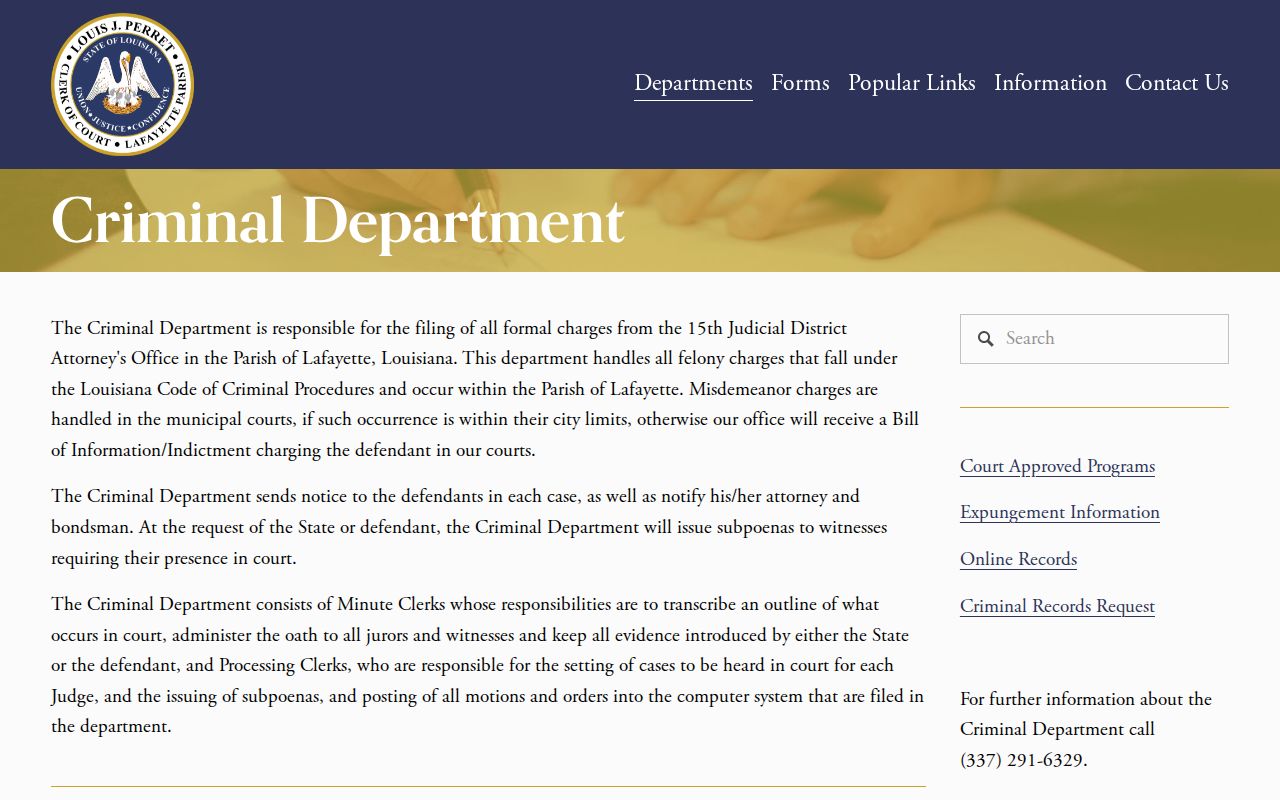
The image connects the local court file with the relief process.
Published fees normally total $550: $200 clerk, $250 BCII, $50 district attorney, and $50 LPSO; DWI adds $50 to DPS. Eligibility, waivers, and exceptions require current confirmation. Dismissal alone does not erase a booking. After processing, recheck ClerkConnect and obtain another Right to Review.
Parish Jail, State Prison, and Federal Custody
Custody searches have three layers. LPSO addresses parish custody and recent bookings. Louisiana DPS&C covers sentenced state custody and accepts a last name or DPS&C number, with a phone option at 225-383-4580. BOP covers federal custody. Transfers can change physical location, so confirm before visiting.
The Louisiana imprisoned-person locator is the official state layer.
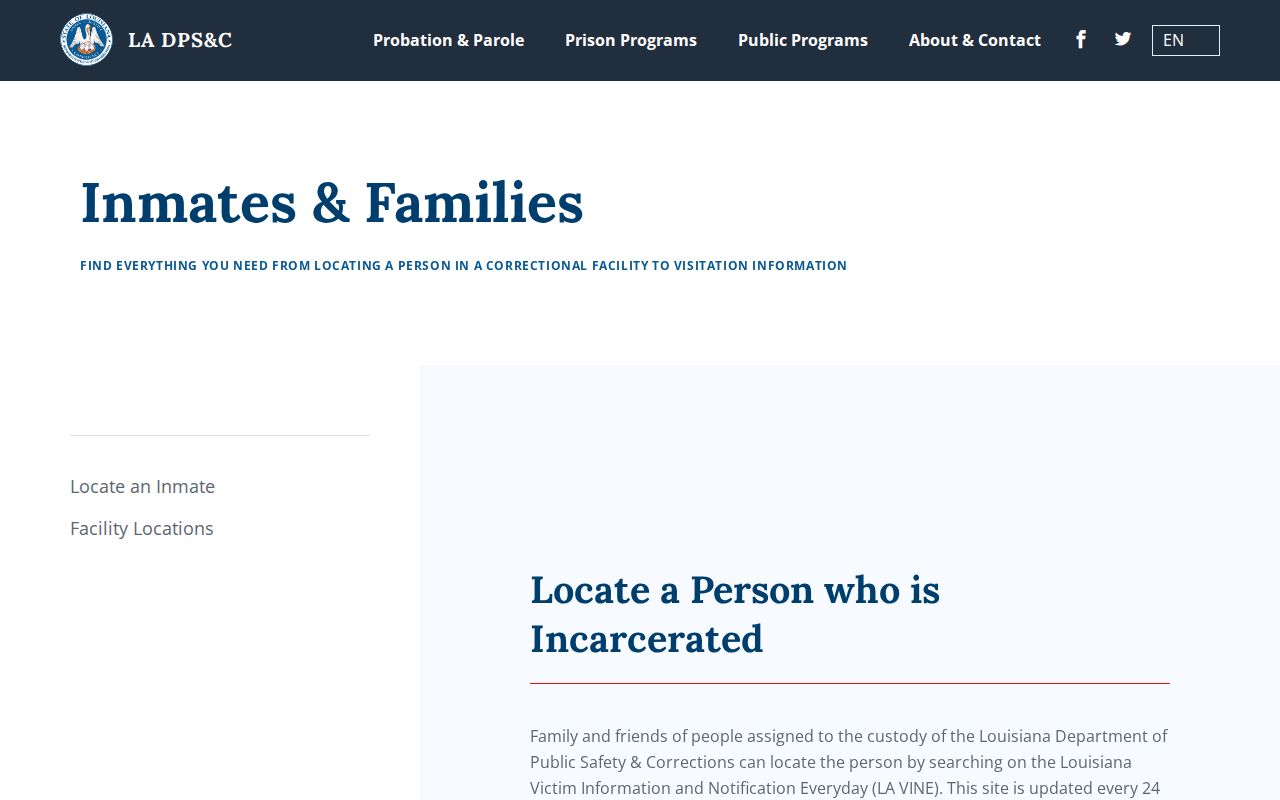
It does not replace LPSO’s recent-booking information or a court disposition.
The Bureau of Prisons locator is the federal layer.
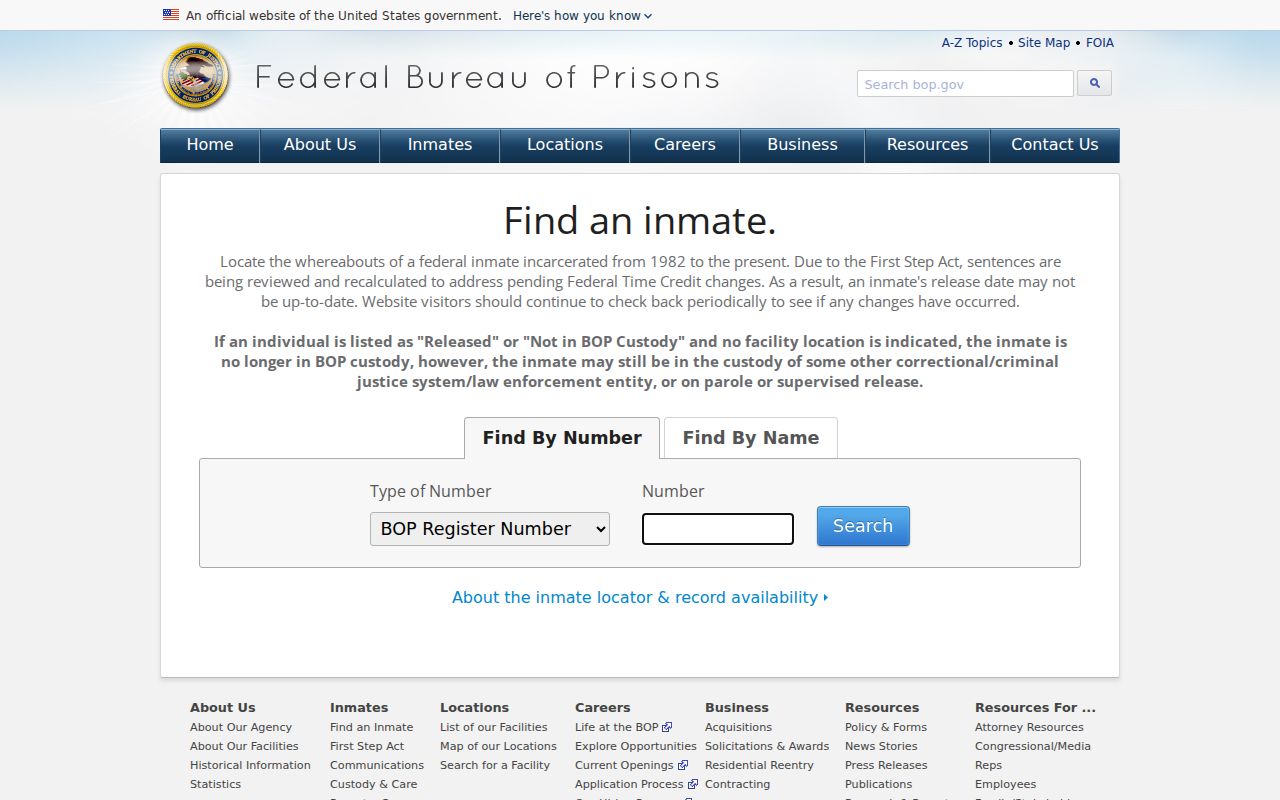
Jurisdiction and prosecuting court, not merely arrest location, determine the correct system.
Federal Cases Use PACER, Not ClerkConnect
Lafayette Parish lies in the U.S. District Court for the Western District of Louisiana. Federal criminal dockets are outside ClerkConnect. PACER requires registration and supplies docket numbers, parties, hearings, judgments, and filings subject to judiciary usage fees and quarterly waiver rules. Federal custody belongs in BOP, not the parish roster.
The official PACER service is the federal case-search source.
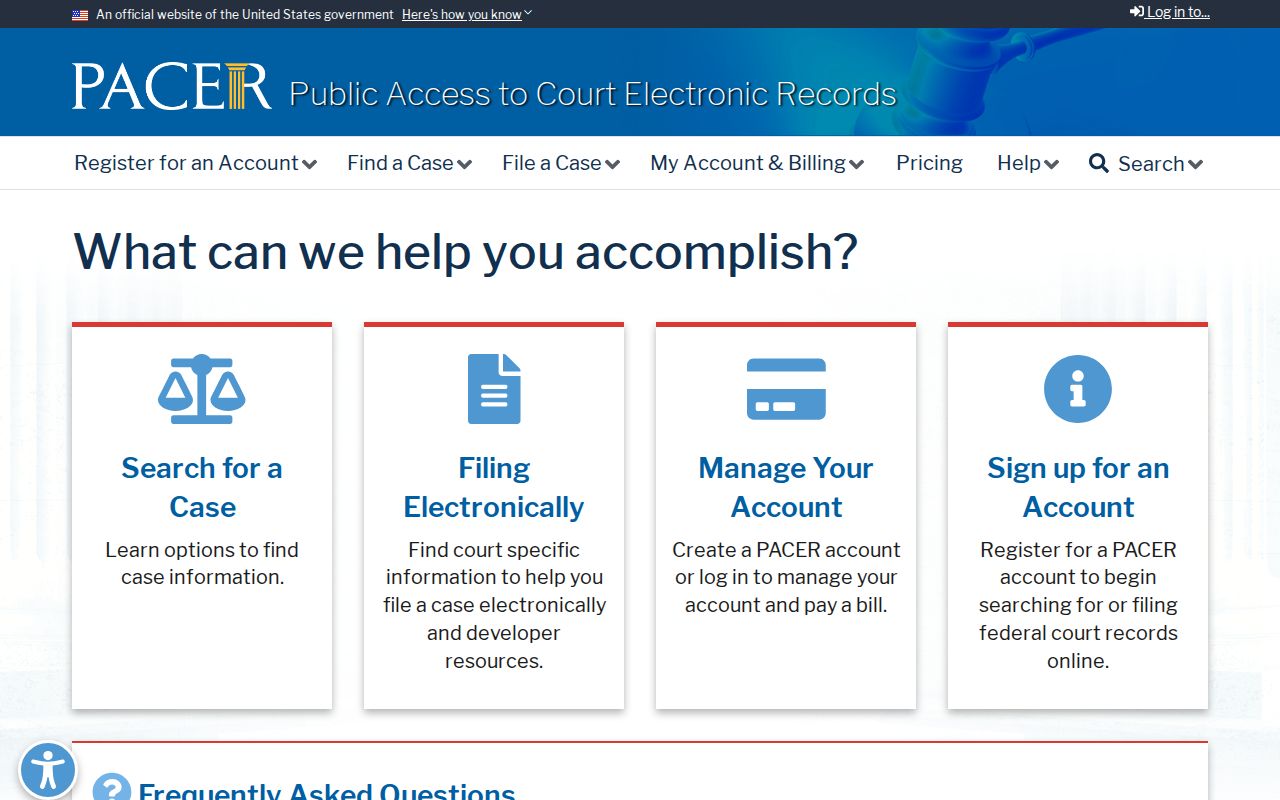
Use PACER for federal cases and BOP for federal custody; neither replaces Lafayette Parish court or sheriff records. The systems can concern the same person while answering different jurisdictional questions.
Probation, Parole, and Lafayette Court Supervision
A sentence entry and an active supervision file are not the same record. The Lafayette Parish Clerk’s minutes and judgment show what the court ordered. Louisiana DPS&C Division of Probation and Parole supervises adult felony probationers and parolees through state district offices, while the 15th Judicial District Court also operates misdemeanor probation and specialty-court supervision functions. Detailed supervision notes are not a substitute for a public docket, and a portal user should not assume that every condition appears online.
Common Louisiana Code of Criminal Procedure article 895 conditions include lawful conduct, truthful monthly reporting, reporting when directed, permitting home visits, maintaining approved occupation, avoiding weapons, paying restitution, and completing ordered testing, treatment, or community service. The research identifies supervised-probation charges of $60–$110 monthly. Parole charges can reach $63 monthly based on ability to pay, plus a $65 per-case processing fee. Those amounts describe supervision obligations, not ClerkConnect access prices or LPSO copy fees.
A violation may lead to a summons or warrant, a contradictory hearing, modified conditions, treatment, day reporting, a technical-revocation response, or revocation. Interstate transfer is not accomplished simply by moving; formal Interstate Compact approval is required. To understand a Lafayette Parish criminal history during supervision, compare the signed sentence, later court minutes, and the responsible DPS&C or court-supervision office rather than drawing conclusions from custody status alone.
Why Booking Charges and Filed Charges Diverge
The arresting officer records an accusation at intake, but the district attorney decides what charge to prosecute. A bill of information, indictment, amendment, dismissal, plea, verdict, and sentence then become entries in the clerk file. This means a Lafayette Parish booking can display one offense while ClerkConnect later displays a reduced, amended, substituted, or declined charge. Neither a booking label nor a filed count by itself states the final result.
Fingerprints taken during booking can create or match a State Identification number and support reporting to LACCH. Courts and justice agencies later report dispositions to BCII. If the state history omits or misstates the outcome, BCII requires an original, unaltered certified disposition that matches identity, arrest date, each original or amended charge, result, and sentence. The Lafayette Parish Clerk Criminal Department is therefore the key local source for correcting an incomplete state cycle.
This sequence also explains timing gaps. A recent LPSO record may exist before the prosecutor files anything; a clerk case may show minutes before the state repository receives the disposition; an older paper result may not appear in the same way as a current electronic case. Searchers should record case and booking identifiers, compare dates, and request certification when reconciliation affects their own record.
Criminal Records by City in Lafayette Parish
City agencies add a local layer. Lafayette has a searchable City Court docket; Youngsville uses police requests and a magistrate counter without a discovered public docket; Broussard holds monthly magistrate court and spans Lafayette and St. Martin Parishes. Figures below are common-vintage July 1, 2024 Census estimates.
Lafayette Criminal History
122,280 · City Court search, LPD reports, and LPSO custody
Youngsville Criminal History
19,038 · Police request form and magistrate counter
Broussard Criminal History
15,312 · Monthly court and two-parish routing
City arrests commonly enter LPSO custody systems, but the correct report and court file depend on agency, arrest location, charge, and jurisdiction. Broussard’s parish line is especially important because otherwise similar events can enter different sheriff and clerk chains.