
How to Check Criminal History in Lafayette
Start with the record that answers the actual question. Lafayette Police Department holds its own initial incident and crash reports. Lafayette City Court handles qualifying state misdemeanors, city-parish ordinances, traffic, OWI, and juvenile matters within its jurisdiction. The Lafayette Parish Sheriff maintains the custody record after a city arrest, while the Lafayette Parish Clerk keeps felony-level filings in the 15th Judicial District Court. Louisiana State Police keeps the closed LACCH repository, but it does not offer unrestricted public name searches.
- Ask LPD Records for the initial police or crash report.
- Give the report date, place, people involved, and report number when known.
- Search Lafayette City Court for a city-level docket by name or docket number.
- Use parish booking and criminal court channels if custody or felony prosecution followed.
- For a complete Louisiana record about oneself, use the fingerprint-based State Police Right to Review process.
Compare the intake charge with the filed charge and disposition. They may differ without either record being wrong.
Inside Lafayette Police Records
The LPD Records Section is at 900 East University Avenue, with mail sent to P.O. Box 4308, Lafayette, LA 70502. Call 337-291-8621. Counter hours are Monday through Thursday from 9 a.m. to 4:30 p.m., with an 11 a.m. to 1 p.m. closure, and Friday from 9 a.m. to noon. The unit maintains about 50,000 reports each year, which makes a narrow request far easier to match than a broad request for everything tied to a name.
An initial report costs $7. It may show the synopsis, charged or arrested person identifiers, offense date and time, property or vehicle details, and the responding officers. A crash report is $7.50, a statement is $1, and a person may obtain an LPD history of local arrest dates and charges for $5 with pictured identification and any required release. These are distinct products.
LPD Records Section
900 E University Avenue
Lafayette, LA 70501
337-291-8621
Monday through Thursday, 9 a.m. to 4:30 p.m., closed 11 a.m. to 1 p.m.; Friday, 9 a.m. to noon.
The Lafayette Police Department
LPD is the correct custodian for records its officers created. It is not the same counter as Lafayette Consolidated Government, City Court, the parish clerk, or the sheriff. A report request should identify the incident as closely as possible. Ask for the public initial report if the investigation is still open, since supplemental investigative material may be withheld under state law.
The official Lafayette police report request page shows the city’s report route.
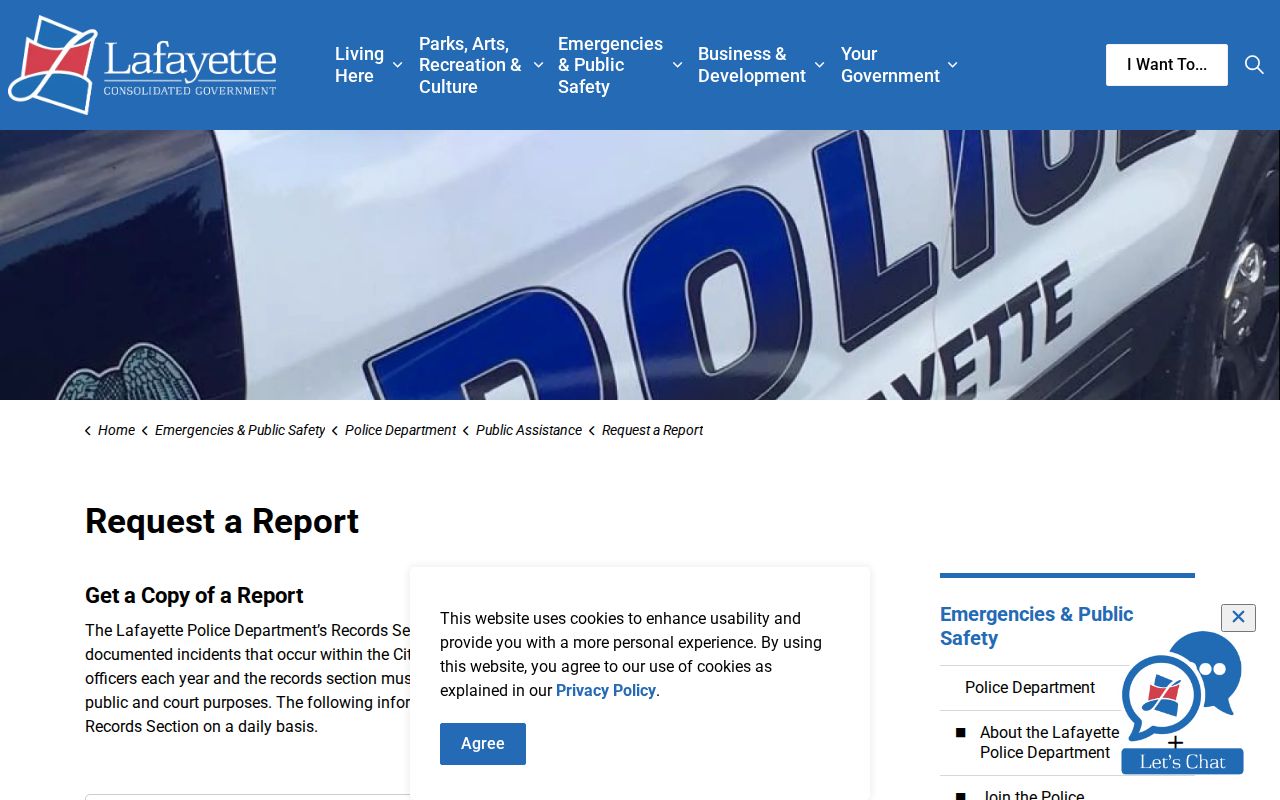
The request page helps separate an LPD report from a parish booking or court file. That choice determines which custodian can answer.
What Lafayette’s Initial Report Shows
The $7 initial report is the practical public starting point, not a complete investigation file. Louisiana law preserves public access to core initial-report facts even when specified investigative material remains restricted. Requesters can therefore ask for the report’s public portion and, if a record is partly withheld, ask the custodian to release segregable material after protected details are redacted.
A full arrest report follows a different rule at LPD and requires a subpoena. Do not treat the low-cost initial report as a promise of witness interviews, evidence analysis, body-camera footage, or every officer narrative. Those items may have separate charges or legal limits. Body or car video costs $25 by electronic link, $30 on CD, or $40 on USB under the city schedule. The format choice matters when requesting a large file.
Note: An arrest report records an accusation and investigation; it does not prove a conviction.
Arrests and Bookings in Lafayette
LPD may make the arrest, but the Lafayette Parish Sheriff’s custody system becomes the next stop. A city police report answers what LPD documented. The sheriff’s booking entry answers whether the person entered parish custody, the intake charge, booking time, bond, and release information. A no-result can reflect release, transfer, spelling differences, delayed entry, another jurisdiction, or a confidential juvenile matter.
After the prosecutor makes a charging decision, the court file becomes more useful than the booking label. City-level misdemeanors may remain in Lafayette City Court. Felony prosecution routes to the Lafayette Parish Clerk and 15th Judicial District Court through ClerkConnect or a direct criminal-record request. The Lafayette Parish arrest history page explains current and recent custody searches.
Body-Camera Video Through JustFOIA
Lafayette Consolidated Government uses JustFOIA for broader public-record requests. A requester describes the item, reviews the request, submits it, and receives confirmation and tracking. The portal can carry messages, an estimate, payment, and downloads. An account is recommended but is not mandatory. Keep the request narrow by naming the incident date, location, report number, officer, and desired video segment when those facts are known.
JustFOIA does not erase the line between city custodians. A City Court case document still belongs with City Court, and an LPD initial report follows the police records route. Video also has its own city schedule: $25 for an electronic link, $30 for a CD, or $40 for a USB. Ask whether review, redaction, or a large file will affect the estimate before paying.
Note: Portal tracking proves submission and helps preserve messages; it does not guarantee that every requested part is public.
City Misdemeanor or District Felony
Lafayette’s court split prevents one portal from being a complete city criminal record check. City Court hears qualifying state misdemeanors, Lafayette Consolidated Government ordinances, traffic and OWI matters, plus juvenile cases within its jurisdiction. Felony cases belong in the 15th Judicial District Court after filing. A booking charge can later be amended, reduced, or declined, so search the court that received the filed charge.
| Question | City channel | Parish channel |
|---|---|---|
| Police event | LPD initial report | Sheriff report only if LPSO created it |
| Current custody | No separate city jail search | LPSO inmate search |
| Case result | Lafayette City Court | ClerkConnect or clerk copy request |
Use the docket number whenever possible. It avoids matching two people who share a name.
Lafayette Municipal Court Records
Lafayette City Court is at 105 East Convent Street. It was established in 1910 and is open Monday through Friday from 8:30 a.m. to 4 p.m. Call 337-291-8720. Its case search opens after an “I Understand” notice and accepts a docket number or name. Data refreshes every 30 minutes and does not supersede the official file.
The official Lafayette City Court site provides the court’s contact and service entry point.
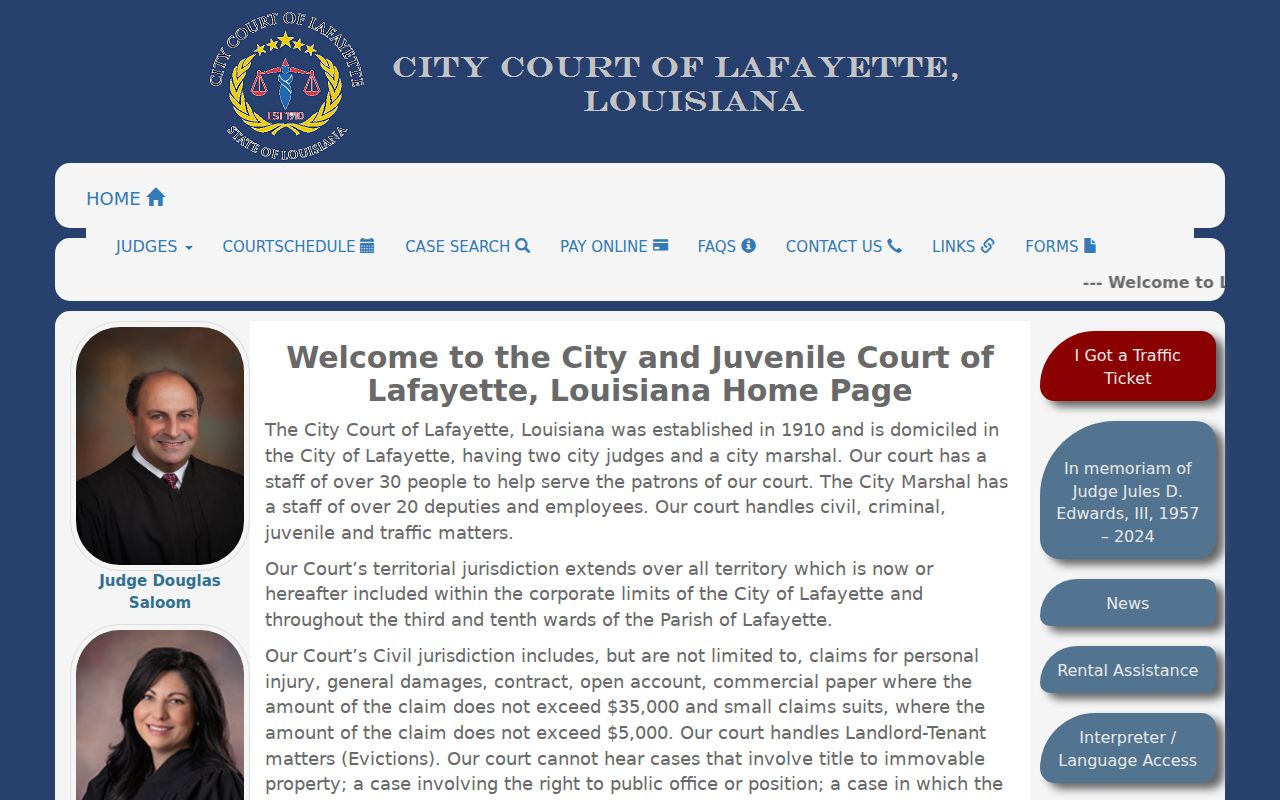
The court source is the place to confirm a city disposition, sentence, or payment status rather than relying on an older portal summary.
| Court Name | Lafayette City Court |
|---|---|
| Case Types Heard | Qualifying state misdemeanors, LCG ordinances, traffic, OWI, and juvenile matters |
| Case Lookup Channel | Free online search by docket number or name, plus clerk contact |
| What the Docket Shows | Case identifiers, violations, events, disposition, sentence, and financial entries when posted |
| Copies & Fees | Confirm the current document and copy charge with the court |
Docket Number or Name Search
The City Court case search offers two controls: Docket Number or Name. The official image below captures that access point without relying on a private people-search service.
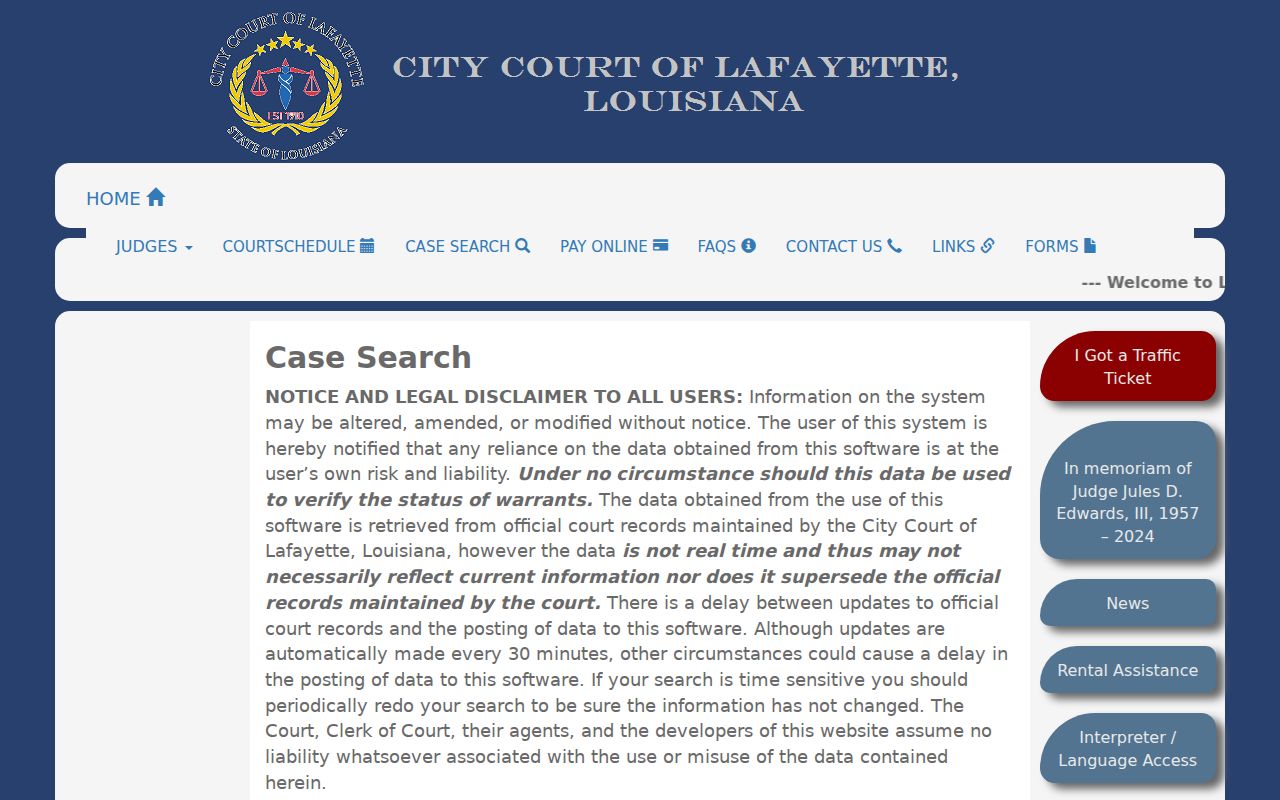
A citation can take ten working days to enter. Waiting through that posting window may solve a missing-result problem. For a current or high-stakes status, call the court because the online data refresh does not make the tool a warrant check.
Payment changes the case. Online fine payment adds a nonrefundable 5% fee and constitutes a guilty or no-contest disposition. It waives arraignment, counsel, trial, and appeal rights. Mandatory-appearance citations cannot simply be paid.
Where Lafayette Records End Up
A city event can create several records at different times. LPD makes the incident or arrest report. LPSO records parish booking and custody. The prosecutor decides what charge to file. City Court or the 15th Judicial District Court records the case result. Fingerprints and agency submissions can then form an arrest cycle in the Louisiana Computerized Criminal History repository.
Record flow: Lafayette PD › Lafayette Parish custody and courts › Louisiana State Police Bureau of Criminal Identification and Information
The newest source is not always the most complete. The booking log is best for recent custody, the court file for the filed charge and disposition, and a fingerprint-based Right to Review for one’s own Louisiana repository record. If LACCH lacks a disposition, obtain an original certified court disposition that matches the name, birth date, arrest date, charges, result, and sentence, then follow BCII correction instructions.
City Marshal for Warrant Status
The City Court search expressly says it is not a warrant verification tool. Lafayette City Court warrants route to the Lafayette City Marshal. A capias is a court command to take a person into custody, often after a missed appearance or noncompliance. Because active or sealed warrants may not appear in public search results, direct court or marshal confirmation is safer than drawing a conclusion from a blank result.
Do not appear at an office to test an uncertain warrant without first considering legal advice. A case search can still help identify the docket number and court, but it cannot clear the risk on its own. Parish or district warrants may involve another enforcing office, so confirm which court issued the process.
Public Access Rules
The Louisiana Public Records Law starts from access to government documentary material unless another law creates an exception. For police records, the custodian may protect specified investigative material while initial reports, booking records, summonses, citations, and filed bills of information remain public. Juvenile identities, protected victims, medical information, security methods, and expunged material may require redaction or withholding.
Ask the office that created the record. Describe the date, location, report or case number, and exact document sought. If copies are not needed, ask about inspection. Public access does not authorize threats, harassment, retaliation, or use of public data for an unlawful purpose.
Key Statutes:
Louisiana Public Records Law, R.S. 44:1 broadly defines public records subject to legal exceptions.
Louisiana R.S. 44:3 protects specified investigative material but preserves access to initial reports and listed booking or charging records.
Louisiana R.S. 15:587 limits dissemination of repository criminal history and does not create an open public name search.