
Criminal Cases in Lafayette Parish Courts
The Fifteenth Judicial District Court has original jurisdiction over criminal matters in Lafayette, Acadia, and Vermilion Parishes. Lafayette Parish felony and district criminal cases are allotted mainly among Divisions A through G and I through L. The Lafayette Parish Clerk of Court is the custodian of those district files. Its Criminal Department keeps the docket, filed charges, minutes, hearing entries, dispositions, sentences, and copy records at the parish courthouse.
Lafayette City Court separately handles qualifying state misdemeanors, city and ward ordinances, traffic, OWI, and juvenile matters within its jurisdiction. A City Court docket is not interchangeable with a 15th JDC file. Searchers should use the issuing court's case number whenever possible and contact that court when jurisdiction is unclear.
ClerkConnect Lafayette Criminal Case Access
The Clerk's online-records page explains that Lafayette criminal and traffic information is sold through ClerkConnect. Access costs $10 for one day, $25 for 30 days, or $300 for 365 days. Printed pages cost $1, while a minute entry costs $10. Since the 2025 migration, account holders register and buy subscriptions or copies by credit card through ClerkConnect rather than using an old clerk-managed login.
The official online-records screen illustrates where the parish directs remote court searches.
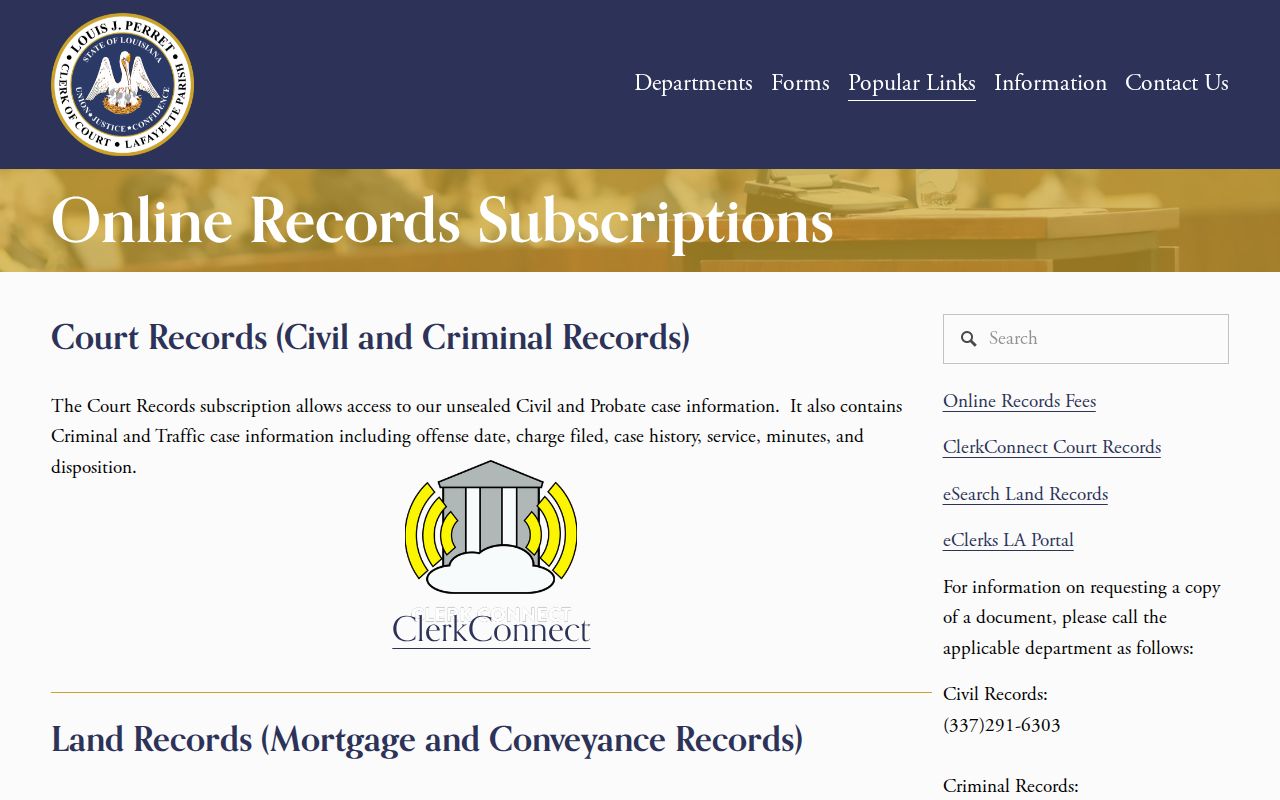
That route is best for repeated docket review; a one-off certified record may be cheaper and clearer through the Criminal Department.
How to Search Lafayette Parish Case Records
Use ClerkConnect for district criminal and traffic cases. Full query controls sit behind registration and paid access. Start with a case number when known. A party name can locate candidates, but names alone can produce several records. Compare the court, filing year, offense date, filed charge, and case history before relying on a match.
- Register or sign in at ClerkConnect, choose the Lafayette office, and select criminal or traffic records.
- Enter the case number for the tightest match, or search by the party's first and last name.
- Narrow possible matches with the filing year, offense date, case type, court, and available identity fields.
- Open the case history and read the filed charge, service, minutes, hearings, disposition, and sentence entries in sequence.
- Call Criminal Records at 337-291-6329 for a plain or certified copy when the portal summary does not establish the exact legal result.
| Field Label | Type | Required | Notes |
|---|---|---|---|
| Last Name | Text | No | Use the legal spelling and test known aliases separately. |
| First Name | Text | No | Refines a name search but does not establish identity alone. |
| Case Number | Text | No | Best exact locator when copied from a notice or court paper. |
| Date or Year | Date/select | No | Compare filing and offense dates because they can differ. |
| Parish and Case Type | Select | Yes after login | Choose Lafayette and the correct criminal or traffic collection. |
Lafayette Criminal Cases by Court
Jurisdiction determines where a Lafayette Parish criminal record lives. Begin with 15th JDC and the parish clerk for felony charges and district criminal matters. Check Lafayette City Court separately for matters within its limited local jurisdiction. City Court offers a free case search with an “I Understand” gate and lets a reader select docket number or name. Its results can show case status, occurrence details, original and amended violations, disposition, financial fields, sentence data, and event dates.
The City Court data refreshes about every 30 minutes, but its warning says the display is not real time and never supersedes the official file. It must not be used to verify a warrant. Call the criminal, traffic, and OWI line at 337-291-8720 option 2 when current status matters.
What Lafayette Parish Case Files Show
A clerk file is case-centered. It records what the prosecutor filed and what the court did afterward. The docket may include a complaint, bill of information, service returns, motions, minutes, plea or trial result, judgment, sentence, and financial entries. A signed judgment or certified disposition carries more weight than a portal summary when a precise outcome must be proved.
| Case Number & Court | Identifies the docket, court, division, status, and filing sequence. |
|---|---|
| Charging Document | Shows the filed bill of information, complaint, or indictment and later amendments. |
| Docket Entries | Lists service, motions, minute entries, appearances, pleas, and court rulings. |
| Hearing Dates | Records arraignment, pretrial, motion, trial, and sentencing settings. |
| Disposition & Judgment | States dismissal, nolle prosequi, plea, acquittal, conviction, or other result. |
| Sentence & Conditions | May show jail days, suspended time, probation, restitution, costs, and concurrent or consecutive terms. |
Reading Lafayette Criminal Case Charges
The arrest charge is an accusation recorded at intake. The district attorney decides what to file, so the bill of information may reduce, amend, replace, or omit that charge. Read the original and amended violation fields beside the disposition. “Nolle prosequi” means the prosecutor chose not to continue the charge at that time. A dismissal ends that charge without a conviction, but it does not erase the arrest record by itself.
The Fifteenth Judicial District Attorney is the prosecuting office for district cases.
Comparing the prosecutor's filed charge with the clerk's final minute avoids treating an intake allegation as the court result.
Stages of a Lafayette Parish Criminal Case
After an arrest and booking, the prosecutor makes the charging decision. A filed charge receives a court docket. At arraignment, the defendant hears the charge and enters a plea. Pretrial settings allow discovery, motions, and negotiation. A plea, dismissal, or trial then produces the disposition, followed by sentencing when there is a conviction. Timing varies by division, case complexity, custody, motions, and the court calendar.
Case flow: Charges Filed › Arraignment › Pretrial › Plea or Trial › Disposition › Sentencing
The official 15th JDC court calendar separates felony motions and pretrials, misdemeanors, arraignments, traffic, and specialty-court settings.
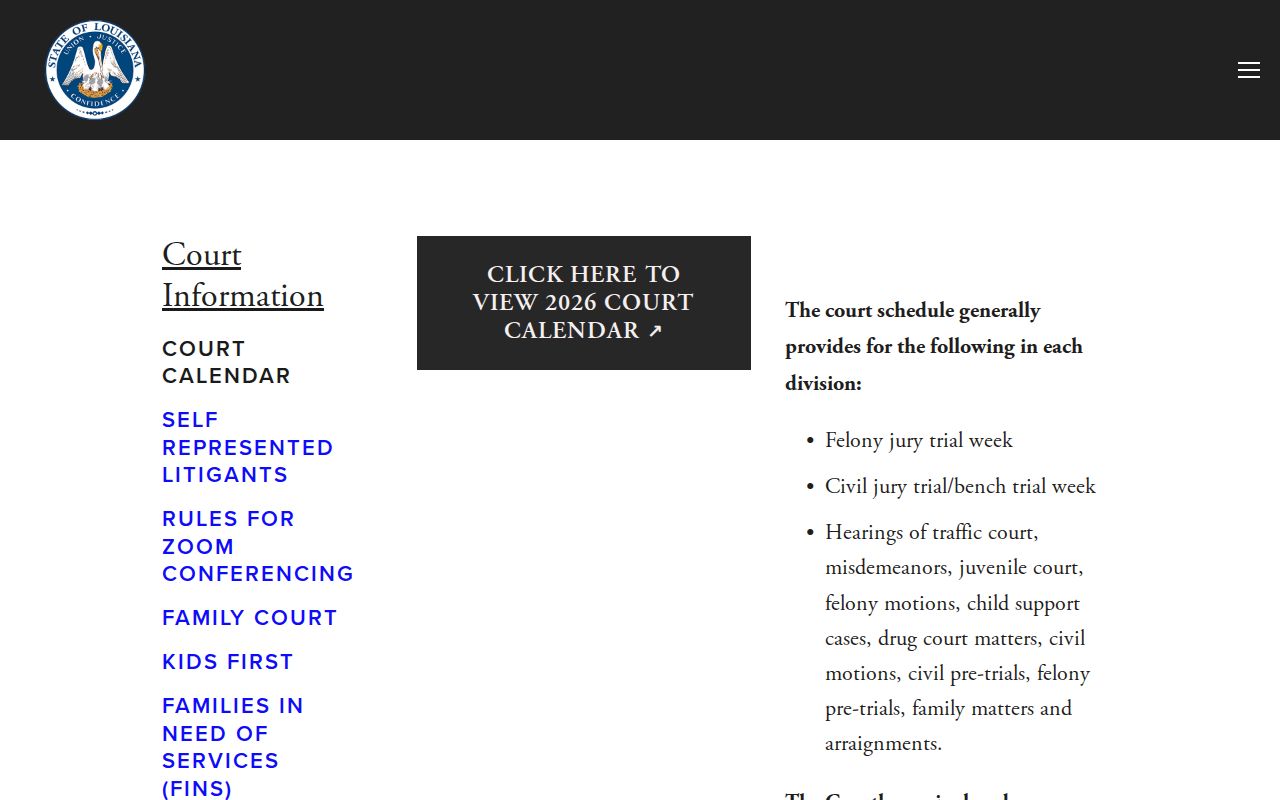
The calendar supplies the setting, while the clerk's minute confirms what occurred in the case.
Lafayette Criminal Case Pleading Dates
Local procedure can change how a docket reads. Division L explains that its Track 3 arraignments are handled by the commissioner. Defendants receive a pretrial date, motions are fixed for that date, and trials are set in open court. A separate mandatory Pleading Date is the final negotiated-plea opportunity. That label is not itself a disposition. The later minute must show whether a plea was entered or the case moved forward.
Division L also accepts telephone requests to review bench or fugitive warrant recalls. Staff review requests at least daily and return status to the number supplied. Repeated calls do not speed review. City Court's delayed web docket remains unsuitable for warrant confirmation.
Lafayette Criminal Court Offices
The 15th JDC's official site identifies its divisions and Lafayette Parish jurisdiction.
Use the court calendar for settings and the Clerk Criminal Department for the actual file, not the court homepage alone.
People entitled to appointed representation can find local office details through the District 15 public defender.
The defender office is a legal-service contact, while court copies still come from the clerk who maintains the docket.
Lafayette Case Access and Restrictions
Louisiana Public Records Law broadly treats government documentary material as public unless another law creates an exception. La. R.S. 44:3 keeps specified investigative material protected while making initial reports, booking records, summonses, citations, and filed bills of information public. Court access still requires redaction of protected victim details, juvenile information, full Social Security numbers, medical data, and sealed or expunged material.
A missing online result does not prove that no Lafayette Parish criminal case exists. The record may sit in City Court, use a different spelling, predate complete online coverage, be restricted, or require staff research. Give the clerk a name, approximate filing or offense date, and case number if known. Ask for segregable public portions when only part of a file is exempt. Louisiana expungement removes eligible records from public access but does not destroy the underlying record.