
How to Check Criminal History in Youngsville
A Youngsville record check works best when the request follows the record’s custodian. The Youngsville Police Department holds reports made by its officers. Its public-record form covers accident, incident, and other records. The city does not publish a criminal-case database. Municipal citations go through the Magistrate Court by phone or counter, while custody and many filed criminal matters continue at parish level.
- Use the Youngsville police public-record form for an accident, incident, or other agency report.
- Supply known dates, times, addresses, involved parties, and contact details.
- Call the Magistrate Court for municipal citation status because no official docket search was found.
- Check LPSO custody and the Lafayette Parish clerk when the arrest or charge moved beyond city channels.
- Use Louisiana State Police Right to Review for a fingerprint-based copy of one’s own statewide record.
A police report, booking entry, and disposition answer different questions. Compare them rather than expecting one result to contain the full history.
Records Clerks on Lafayette Street
Youngsville Police Department is at 311 Lafayette Street, P.O. Box 310, Youngsville, LA 70592. The records number is 337-856-5931 and fax is 337-856-4904. Office hours are Monday through Thursday from 7 a.m. to 4 p.m. and Friday from 8 a.m. to noon. The official city information names Chief Jean Paul “JP” Broussard and Assistant Chief Kenny Duhon.
Records clerks file and retrieve the department’s reports for officers, legal professionals, and members of the public. Give a precise incident description. A broad demand based only on a common name can delay matching and may sweep in protected information. If the request concerns a city administrative record rather than a police-created file, confirm the right city custodian before submitting it.
Youngsville Police Department
311 Lafayette Street
Youngsville, LA 70592
337-856-5931
Monday through Thursday, 7 a.m. to 4 p.m.; Friday, 8 a.m. to noon.
The Youngsville Police Department
YPD is the first source for an incident investigated by a city officer. Ask for the initial report and identify the event by date, time, address, and people involved. Louisiana law can preserve specified investigative material from disclosure even while the initial report remains public. That distinction means a requester may receive the core event record without every interview, evidence note, or investigative supplement.
The official Youngsville police public-record page presents the local request route.
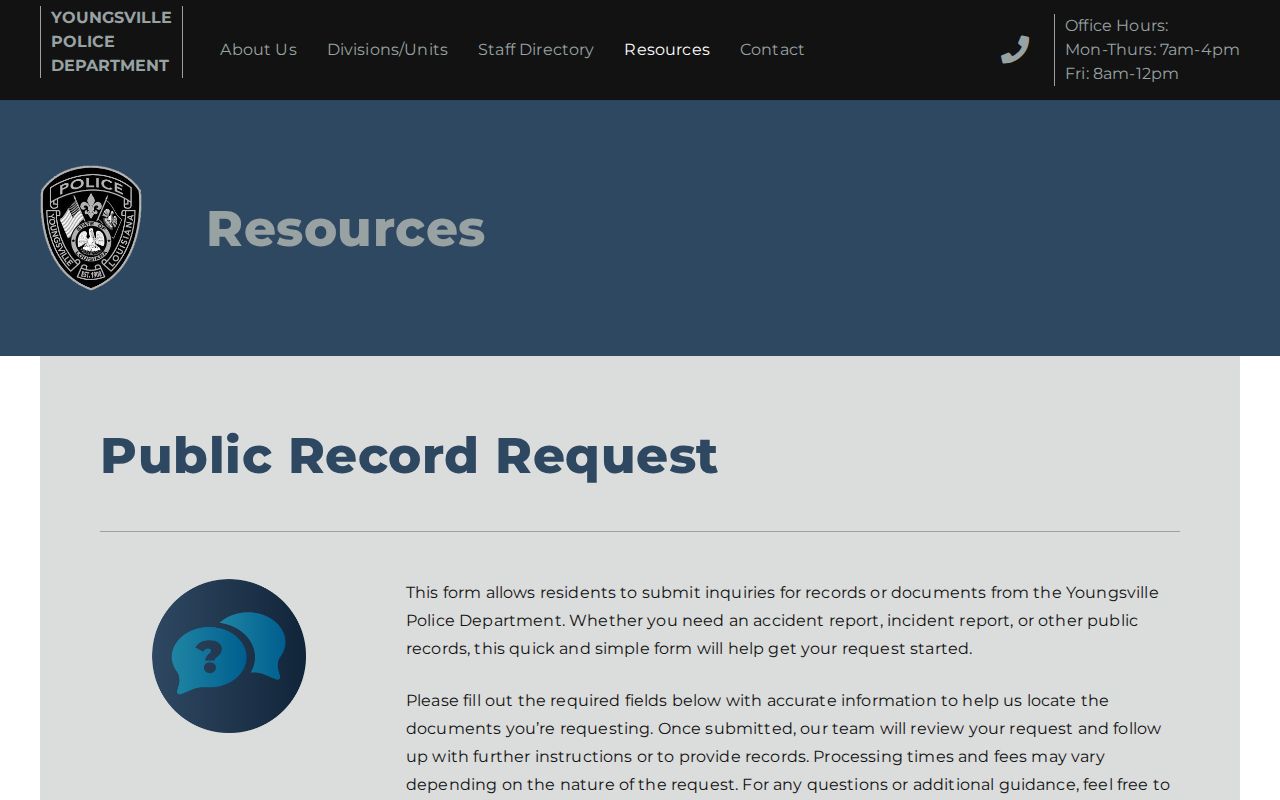
The form is a report-request tool, not a people-search database. Its fields help the records clerks identify a specific agency file.
Youngsville’s Five-Part Records Form
The web form asks for the requester’s first and last name, full address, telephone number, email address, and a narrative under “Information Requested.” Each group is required. The narrative should list known dates, times, addresses, and parties. That detail tells the custodian which report is sought and reduces the chance of receiving an estimate for an overly broad search.
| Form field | Input | Required |
|---|---|---|
| First and Last Name | Text | Yes |
| Full Address | Address controls | Yes |
| Phone | Telephone | Yes |
| Yes | ||
| Information Requested | Long text | Yes |
Processing time and fees vary. The linked fee resource returned an error during research, so no amount should be assumed. Call 337-856-5931 for a current quote and payment instructions before relying on an old schedule.
Arrests and Bookings in Youngsville
Youngsville does not publish a standalone city jail roster. Its police site routes jail questions to the Lafayette Parish Sheriff’s custody tool. After YPD makes an arrest, the local report remains with YPD, but intake information appears in LPSO’s booking system. That entry may show the booking identifier and time, arresting agency, intake charges, bond, and release data.
A booking charge is an accusation at intake. It can change when a prosecutor files, amends, reduces, or declines charges. Current custody belongs in the Lafayette Parish arrest search; the final filed charge and result belong in the appropriate court record. A missing current result can also mean release, transfer, a name mismatch, delayed posting, or juvenile confidentiality.
Report, Ticket, or Jail Query
Three official web routes can look similar while serving different purposes. The public-record form requests a police document. The 24-hour ticket payment tool accepts ticket and payment data. The parish jail tool searches custody. None substitutes for the others, and the ticket transaction does not expose a searchable municipal docket.
| Need | Start here | What it does not prove |
|---|---|---|
| Police event | YPD records form | Final court outcome |
| Municipal citation | Magistrate Court phone or counter | Felony case status |
| Present custody | LPSO inmate search | Conviction |
When a portal gives no result, move to the official phone or counter instead of substituting a commercial aggregator.
Youngsville Municipal Court Records
Youngsville’s appointed Magistrate Court addresses municipal ordinance and citation matters. Research found no official online criminal-case search and no current published copy fee. A reader should contact the city by phone or at the counter for the citation status, court date, disposition, or a copy request. Bring the citation number, name as written, and event date if known.
| Court Name | Youngsville Magistrate Court |
|---|---|
| Case Types Heard | Municipal ordinances and city citation matters |
| Case Lookup Channel | Telephone or counter; no official online docket found |
| What the Docket Shows | Citation, setting, plea or disposition, sentence, and payment entries as applicable |
| Copies & Fees | Ask the court for the current availability and charge |
Do not mistake the online payment page for court research. A transaction screen may process a known ticket without showing the complete case file or other matters tied to a person.
No Youngsville Municipal Portal
The lack of an online docket changes the search method, not the existence of a court record. Call and state the precise document or status needed. Ask whether the court can confirm the next date, provide a plain or certified copy, and explain the current delivery and payment method. Certified means the clerk attests that the copy matches the official file.
For a felony or another matter filed in the 15th Judicial District Court, use ClerkConnect or contact the Lafayette Parish Clerk Criminal Department. The criminal court case page explains that route. Portal summaries can omit a signed judgment or minute entry, so request the source document when the result matters.
A name alone may be too weak for a reliable match. Provide a docket or citation number whenever possible, then add the full name and date of birth only through the court’s approved channel. Ask whether the matter is pending, disposed, or transferred. “Disposed” means the court has entered an outcome; it does not always mean that every payment, probation term, or later compliance entry is complete. If the court sends the requester to another office, note the destination and the type of case before restarting the search.
Where Youngsville Records End Up
YPD creates the police report. LPSO creates a booking record when the person enters parish custody. The prosecutor selects the filed charge. The Magistrate Court or 15th Judicial District Court records the disposition. Fingerprint and disposition submissions may then update the Louisiana Computerized Criminal History repository.
Record flow: Youngsville PD › Lafayette Parish Sheriff and Courts › Louisiana State Police Bureau of Criminal Identification and Information
For a recent event, begin close to the source. For an older case, use the court disposition. A person reviewing their complete Louisiana record must use the fingerprint-based Right to Review route because Louisiana does not provide a casual public name search of LACCH. If a repository record lacks a result, a certified disposition from the court supports correction.
Youngsville’s Fast-Growth Record Context
The July 1, 2024 Census estimate places Youngsville at 19,038 residents, about 19.5 percent above its 2020 base. Growth helps explain why a structured request form and precise identifiers matter to a local records office. It does not establish a crime trend. Research found no current official city offense-count table, so population change should not be paired with an unsupported claim about criminal activity.
The official Youngsville city site provides the city context shown below.
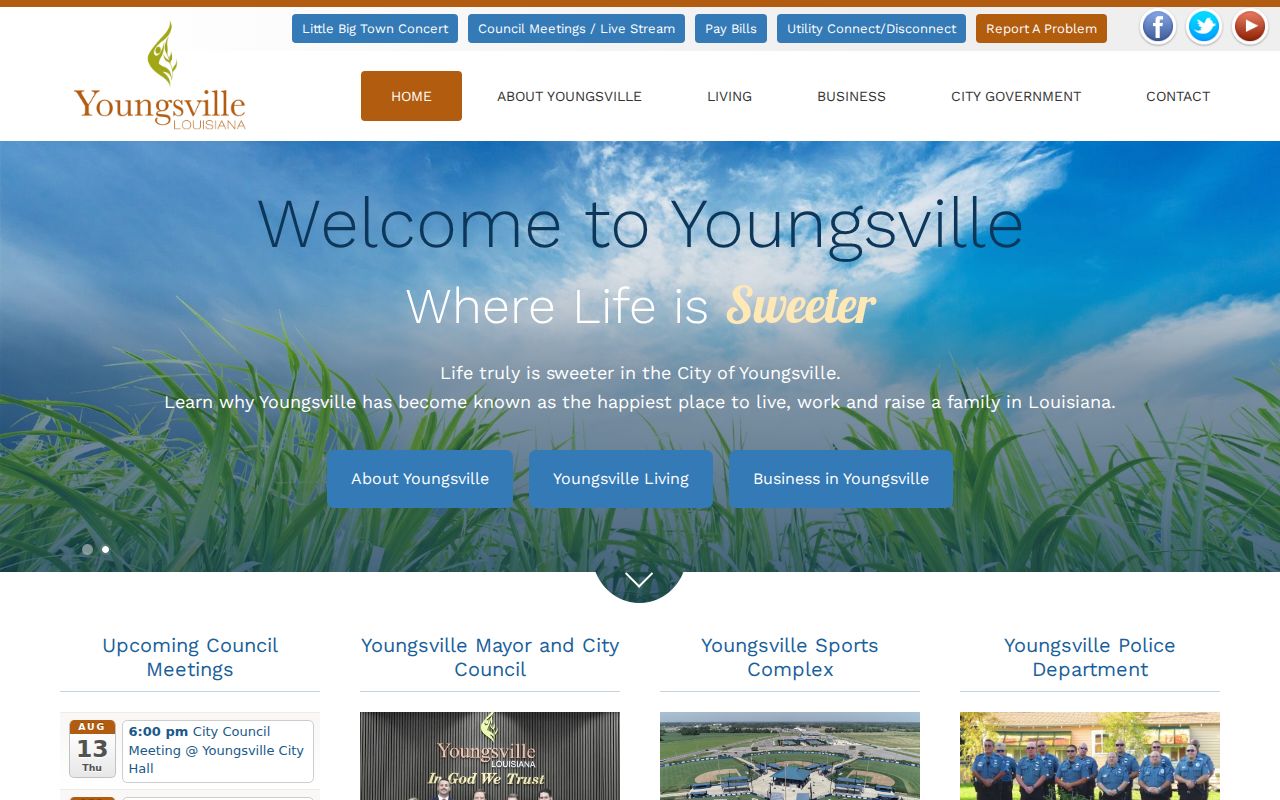
The city channel is useful for offices and services, while police, court, and parish custodians still control their own records.
Royville to Young Village
The community began as Royville after Charles Abraham Roy’s family settled in 1834. Postal confusion with Rayville contributed to the 1908 Youngsville name, drawn from “young village.” Youngsville became a town in 1983 and a city in 2006. Official history also records a World War II German prisoner-of-war camp near present Foster Park and a destructive sugar refinery fire in 1969.
These milestones belong to city history, not to modern criminal-history counts. Their practical value is jurisdictional: names, city status, and local institutions can change over time, so older records may be indexed under another description or held outside a current online system. Give the custodian the date and historic place name when seeking an archival event.
Public Access Rules
Louisiana’s Public Records Law broadly covers government documentary material unless a constitutional or statutory exception applies. For a Youngsville police event, the initial report can remain public even when specified investigative material is withheld. Booking records, summonses, citations, and filed bills of information receive specific access protection. Juvenile identities, protected victims, medical details, security methods, and expunged records may be redacted or closed.
Ask for the public, segregable part if a file includes exempt material. Public availability does not turn a record into a consumer report. It also does not permit harassment or retaliation.
Key Statutes:
Louisiana Public Records Law, R.S. 44:1 defines covered public records and recognizes legal exceptions.
Louisiana R.S. 44:3 protects specified investigative files while keeping listed initial, booking, citation, and charging records public.
Louisiana R.S. 15:587 restricts dissemination from the state criminal-history repository.